

Be Unreasonable
The Radical Power of Giving More Than Expected

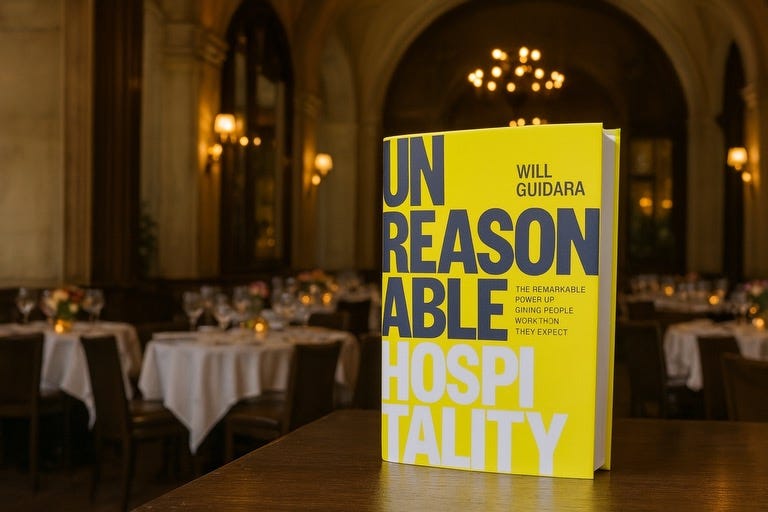
Will Guidara’s Unreasonable Hospitality: The Remarkable Power of Giving People More Than They Expect is far more than a memoir about elevating a restaurant. It is a manifesto for a new era of business: one in which human beings, not efficiency or algorithms, form the beating heart of organizational success.
Will’s book sits in perfect alignment with the mission and values of the Dave Alexander Center for Social Capital, which champions people-centric business strategies and insists that human connection is not merely a centerpiece but the ultimate asset.
Will’s leadership journey — from a 26-year-old taking over a languishing brasserie to co-architecting the best restaurant in the world — reads like an operatic tale of reinvention. But beneath the spectacle of snow machines, surprise vacations, custom-made gifts and moments of pure cinematic hospitality lies a deeper truth:
When people feel seen, valued and delighted, they give their best work, stay longer and elevate an organization beyond what metrics alone can measure.
In an age obsessed with scale, speed and automation, Unreasonable Hospitality reminds us of something timeless: People will always remember how you made them feel.
The Human Desire to Belong: The Hidden Engine of Excellence
Will confesses early in the book that Eleven Madison Park had been performing service admirably. But in terms of hospitality, well, not yet. This difference becomes the axis upon which the entire story turns.
“Service is black and white; hospitality is color.”
This is the distinction that every contemporary organization, whether in hospitality, healthcare, education, finance or technology, must understand. Service is the transaction; hospitality is the transformation.
Will discovered that no amount of technical ability or culinary innovation could compensate for a lack of human connection. It was only when he and his team began creating experiences so personalized they rivaled movie scenes that Eleven Madison Park ascended from “excellent” to “world-changing.”
And that resonates profoundly with the core philosophy of the Dave Alexander Center for Social Capital:
… that the success of every business ultimately depends on its ability to nurture trust, presence and meaningful relationships.
Food was Guidara’s medium, but the real craft was emotional intelligence.
The Cocktail Napkin That Became a North Star
One of the most compelling scenes in the book is when, after realizing they’d come in dead last on the “World’s 50 Best Restaurants” list, Will and chef-partner Daniel Humm sat outside with a bottle of bourbon and wrote a declaration on a cocktail napkin that read:
“We will be Number One in the world.”
And then Will added two more words which became a philosophy, a strategy and a culture:
Unreasonable Hospitality.
What makes this moment powerful is not the audacity but the clarity. They decided not to innovate by copying techniques from molecular gastronomy or Nordic foraging. Instead, they asked a radical question:
What if we became the best in the world at making people feel cared for?
This is precisely the same question the Social Capital movement asks of today’s business leaders, namely:
What becomes possible when a company chooses to make human beings — rather than systems — the epicenter of what they do?
Over-the-Top Hospitality as a Leadership Model
The stories that emerge from Eleven Madison Park are at once playful and profound:
Sending a family who had never seen snow on a sledding adventure in Central Park
Filling a private dining room with sand and beach chairs for guests who missed their vacation
Orchestrating small, intimate gestures that made people feel not like customers — but like honored guests
These were not gimmicks. They were strategic choices rooted in emotional attentiveness. They flowed from a culture where every team member, from busser to sommelier, was empowered to think like an owner.
Will shows us in the book how unreasonable hospitality is not about extravagance; it’s about intention. It is about noticing, listening and responding in ways that make people feel alive.
This mirrors the Dave Alexander Center for Social Capital’s belief that: Leadership is the art of investing in people so deeply that they willingly invest back.
In both Will’s world and Social Capital philosophy, employees are not workers but relationship-makers. Customers are not revenue streams but rather partners in an emotional exchange. Excellence is not a benchmark, it’s a feeling.
Why the World Needs ‘Excessive’ Humanity
In today’s hyper-rational business climate, hospitality has become undervalued, even dismissed. Efficiency, optimization and automation often replace nuance, empathy and human touch.
Will pushes back with conviction:
Hospitality is not ornamental; it is foundational.
Hospitality is not soft; it is strategic.
Hospitality is not optional; it is transformative.
He reminds organizations that the greatest competitive advantage left in the twenty-first century is humanity — which is precisely what the Dave Alexander Center for Social Capital champions. When companies cultivate belonging, loyalty and meaning, they outperform competitors who rely solely on systems or technology.
Every chapter is a clarion call for leaders to stop thinking in black and white and start painting in color.
Practical Lessons from ‘Unreasonable Hospitality’
Will’s book offers an array of actionable insights that any business can implement. Here are several that align with Social Capital values:
🙌 Hire for heart, not just skill.
Technical competence is the baseline. Curiosity, integrity, generosity and presence are what create trust and belonging.
🙌 Empower everyone to “make magic.”
Provide autonomy and permission for employees to shape the customer experience. Let bussers think like owners.
🙌 Double down on moments that matter.
Will teaches that small gestures often create the biggest impact. A handwritten note, a remembered preference or a surprise delight can transform loyalty.
🙌 Care for your team before expecting them to care for others.
Hospitable cultures are born from internal relationships, not external performance.
🙌 Solve problems by giving more, not less.
One of Will’s central provocations is that generosity, not austerity, is often the more effective business solution.
These practices are not expensive but intentional. And their return on investment is staggering: retention, brand advocacy, culture and emotional resonance.
The Social Capital Connection: Making People the Point
The Dave Alexander Center for Social Capital believes that business has a moral and practical responsibility to elevate humanity. Guidara’s philosophy fits seamlessly into this thesis.
Just as Will transformed a restaurant by re-centering it around the emotional needs of guests and the lived experiences of employees, Social Capital leaders transform companies by re-centering them around people.
Will’s narrative reinforces a point the Center teaches often:
In a world where everything is becoming automated, the rarest and most valuable resource is intentional human connection.
This is what Adam Smith hinted at when he noted that human beings derive pleasure from the prosperity and happiness of others. Hospitality, then, is not merely a strategy. Rather, it is an instinct, one that business leaders must relearn and honor.
A Book for a Changing Economy
Unreasonable Hospitality is perfectly timed for what Guidara calls the “Hospitality Economy” — an era where the way companies treat people will determine their long-term viability.
Reading this book is like being handed a blueprint for the future of human-centered enterprise.
It teaches companies how to move beyond predictable service and into memorable, meaningful experiences that bind customers and employees to an organization with emotional glue.
It tells leaders that the business of the future is not merely to provide goods or services but to cultivate connection, community and belonging.
Which is, at its core, the mission of the Dave Alexander Center for Social Capital.
The Courage to Be Unreasonable
Will Guidara has gifted the world a philosophy both timeless and revolutionary. Unreasonable Hospitality challenges every leader to elevate their organization by elevating humanity to build businesses not on metrics alone, but on meaning.
His message is clear and resounding:
Don’t strive to be the best in the world. Strive to be the best for the world.
And in doing so, you will unlock the remarkable, enduring power of giving people more than they expect.